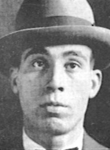
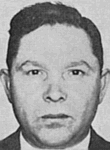
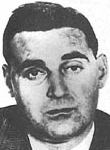
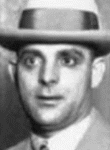
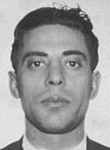
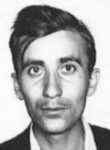
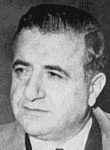
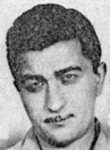
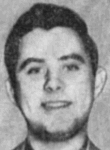
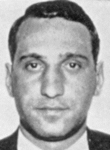
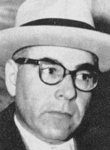
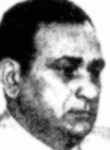
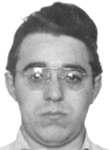
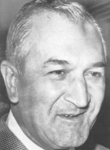
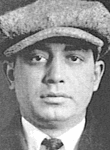
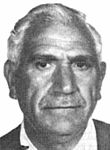
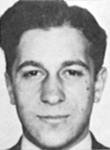
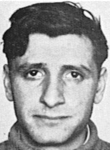
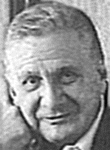
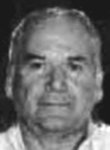
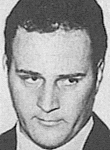
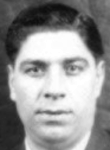
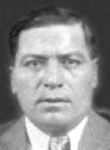
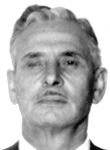
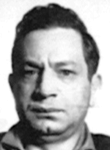
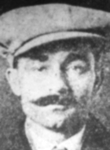
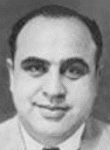
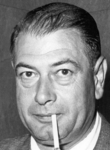
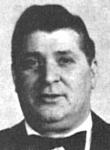
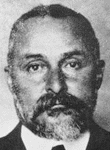
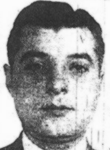
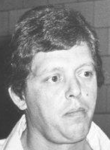
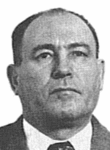
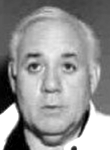
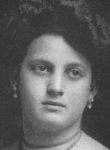
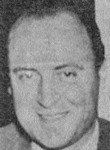
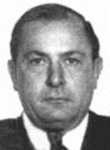
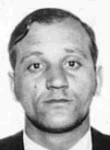
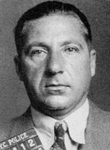
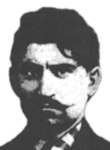
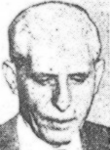
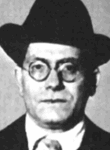
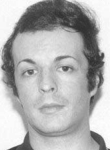
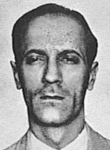
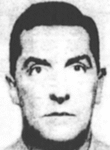
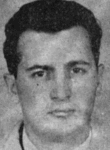
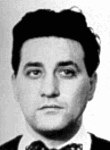
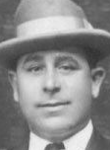
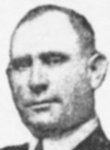
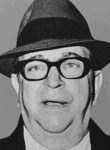
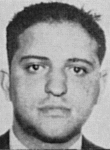
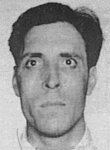
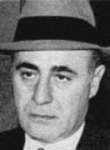
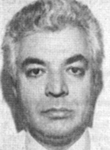
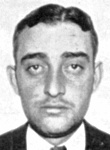
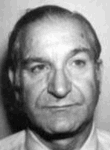
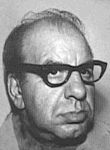
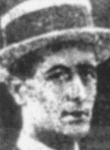
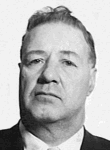
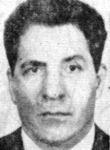
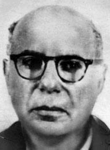
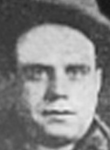
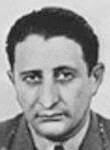
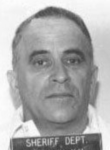
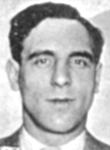
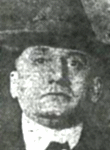
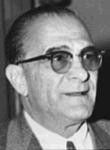
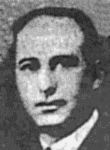
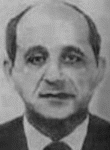
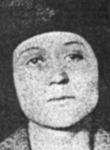
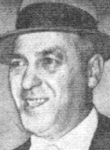

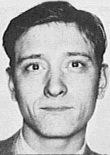
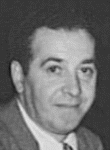
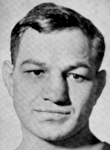
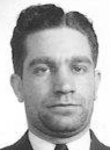
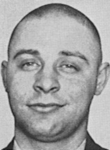
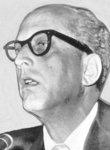
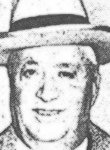
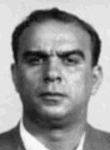
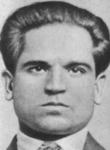
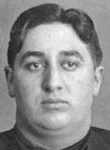
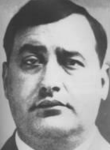
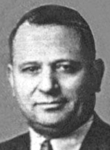
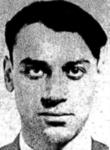
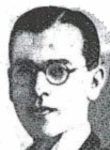
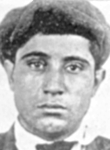
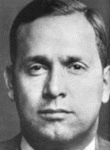
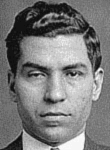
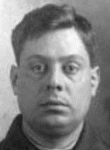
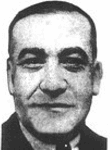
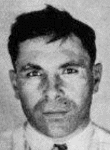
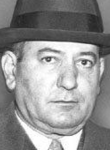
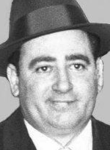
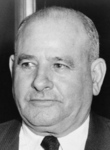
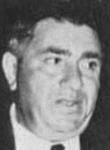
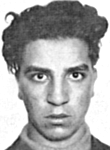
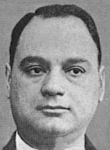
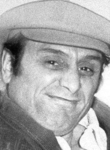
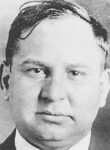

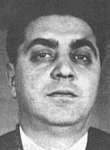
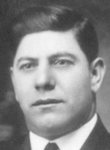
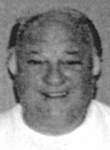
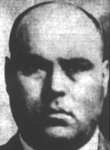
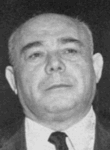
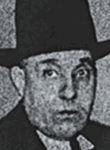
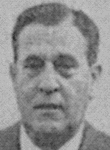
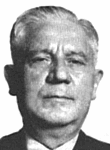
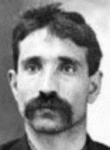
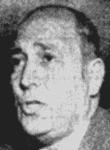
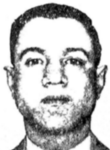
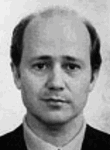
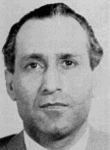

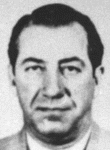
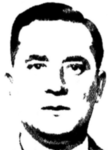
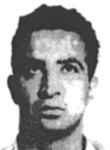
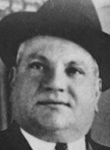
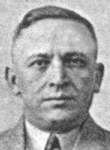
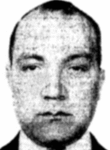
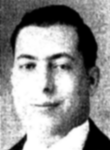
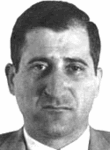
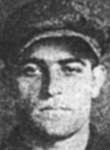
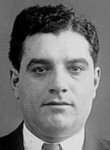
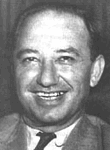
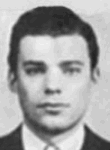
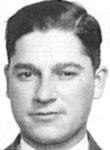
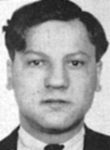
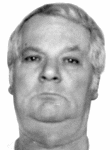
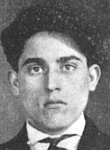
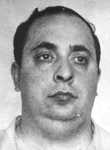
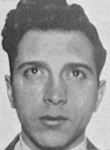
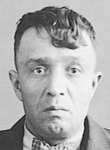
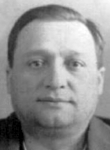
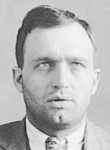
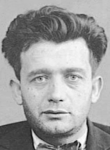
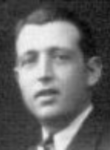
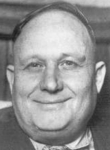
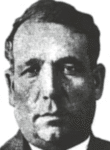
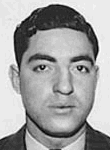
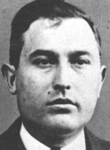
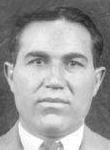
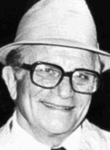
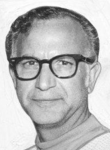
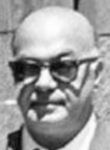
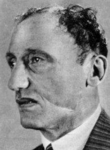
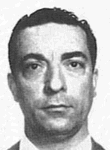
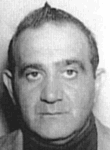
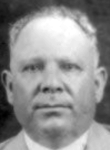
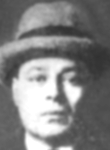
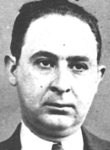
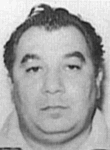
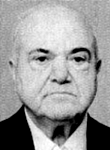
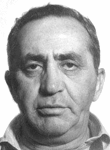
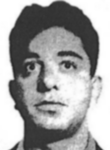
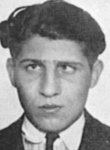
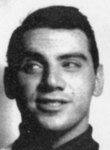
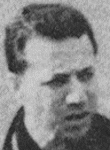
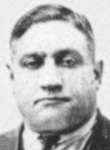
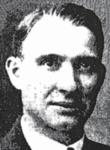
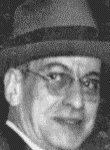
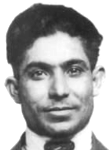
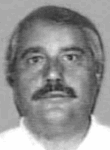
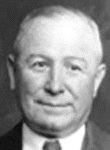
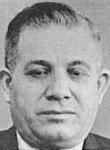
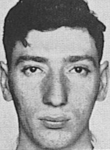
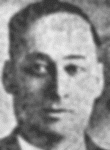
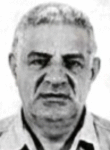
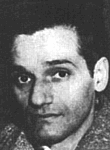
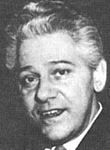
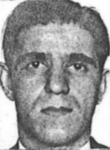
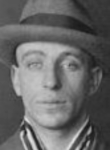
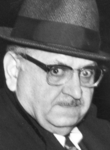
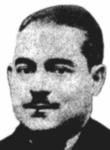
Cassandro Bonasera John Cammilleri Joseph Fino Sam Frangiamore Thomas Hunt Antonino Magaddino Stefano Magaddino Angelo Palmeri Michael A. Tona

Cassandro Bonasera (June 18, 1897, to Sept. 9, 1972)


The Bonasera family has its roots in Vallelunga, Sicily. Vincenzo Bonasera, born there about 1865, and Lucia Spoto, about three years younger, were married in the community and raised their young family there. Cassandro "Tony the Chief" Bonasera was born in Vallelunga on June 18, 1897.

Vincenzo, a tailor, sailed to the U.S. in 1901, settling on Elizabeth Street in New York City. Cassandro Bonasera crossed the Atlantic with his mother and four siblings several years later, arriving in New York harbor aboard the S.S. Madonna on January 1, 1906. They joined Vincenzo on Elizabeth Street.

Lucia Spoto Bonasera died of complications of childbirth on Oct. 24, 1906, less than 11 months after her arrival in the U.S. (The baby also was lost.)

In 1908, Cassandro Bonasera lived with his father and three siblings in a tenement, 442 East 13th Street in Manhattan. He attended Public School 19, registering there under the name Anthony Bonasera. In this period, Vincenzo was self-employed as a tailor, and his older daughters did embroidery work.

Cassandro Bonasera left school upon completion of the sixth grade in 1911. By 1915, the family had relocated to Brooklyn, and was living at 7511 Thirteenth Avenue. The address falls within the Dyker Heights section of Brooklyn, near Bensonhurst.


Bonasera's criminal record (above) began a year later with an arrest for robbery. (Interestingly, when registering for the World War I draft on June 5, 1918, Bonasera indicated that he was uncertain of his date or place of birth.) His second arrest, in 1920, resulted in a conviction for petit larceny and a suspended sentence.

During the 1920s, Bonasera teamed with John "Johnny Bath Beach" Oddo in managing Brooklyn gambling rackets for Mafia leader Frankie Yale (Ioele). More than a dozen arrests were added to Bonasera's growing criminal record in the decade. He was charged with such offenses as homicide, burglary, assault, extortion, and impersonating a police officer. He managed to avoid conviction in most of the cases. An assault conviction in 1920 sent him to the workhouse for 60 days. When convicted of possession of a revolver in 1925, he was sentenced to 18 months in county jail.

NY Herald Tribune, Dec. 23, 1930
The origin of Bonasera's "Chief" nickname is unknown, but the nickname was in place by 1930. Bonasera and his close friend John Oddo became underlings of Mafia boss Joseph Profaci following Frankie Yale's murder in 1928. Bonasera ran floating dice games for the Profaci Family. He was repeatedly questioned by police in connection with Brooklyn homicides, including that of Yale.

On Dec. 22, 1930, Bonasera was seriously wounded in a shooting outside of his Brooklyn home, 7513 Thirteenth Avenue. He was hit in the head, neck and arm by six gangland bullets. True to the underworld code, he refused to identify his assailants to police.

The Bonasera and DiCarlo families had been closely acquainted in Vallelunga, Sicily. Giuseppe DiCarlo, father of Joseph DiCarlo, had been a friend of Vincenzo Bonasera. In 1933, Joseph DiCarlo's sister Sarah traveled with Bonasera's sister from Buffalo to Brooklyn. In Brooklyn, Sarah met Cassandro Bonasera. The two were married in Buffalo on June 28 of that year, with John Oddo serving as Bonasera's best man. Joseph DiCarlo gave away the bride during an elaborate wedding ceremony that was followed by a lavish reception at the Hotel Statler.

Buffalo Courier Express, June 29, 1933
In 1939, a grand jury investigating money-lending rackets in Bensonhurst and Bath Beach, Brooklyn, indicted Bonasera and Oddo for loan sharking and extortion. Extortion charges were dropped in 1941, as Bonasera pleaded guilty to conspiracy to violate banking laws. He was sentenced to four months in prison.

Bonasera claimed in 1952 to be a self-employed dress manufacturer, partner in the Sara Lee Dress Company of 8403 Fifteenth Avenue in Bath Beach, Brooklyn, which employed 30 sewing machine operators. At that time, he resided at 1117 83rd Street in Brooklyn.

The following year, deportation proceedings were started against Bonasera. He was arrested as an undesirable alien on the grounds that he had been convicted of more than two crimes since entering the U.S. A special inquiry of the U.S. Immigration Department revealed that Bonasera had been arrested 25 times between 1916 and 1944. He was ordered deported in 1954. The order was withdrawn on appeal, when it was noted that Bonasera's record included just four convictions and only one could be construed as involving moral turpitude. By law, two such convictions were required for deportation.

Fifty-six-year old Bonasera found himself in an unusual position on Feb. 3, 1954. Two armed thugs approached him outside the Sara Lee Dress Company. One pointed a .45 caliber pistol at "the Chief's" face and demanded he turn over a cardboard box containing the weekly dress factory payroll. "Do you know what you're doing?" Bonasera asked the gunmen. "Do you know who I am?" The robbers were uninterested, and the unarmed Bonasera meekly turned over a cardboard box containing $835.

NY Times, Feb. 4, 1954
In the early 1960s, the Bonasera home in Brooklyn became a temporary residence for the financially troubled Joseph DiCarlo. In 1963, Joseph Valachi identified Bonasera as a member of the crime family commanded by Giuseppe Magliocco since the death of Giuseppe Profaci.

Late in life, Bonasera attempted to acquire U.S. citizenship. His petition for naturalization was denied in 1968. An investigation of his character revealed his long criminal career and close association with underworld figures John Oddo, Giuseppe Profaci, Joe "Adonis " Doto, Joseph Colombo and Charlie "Lucky" Luciano.

Bonasera died of natural causes on Sept. 9, 1972. He was 75 years old. His wife, Sarah DiCarlo Bonasera, passed away three years later, on Oct. 19, 1975.

John Tronolone (Dec. 12, 1910, to May 29, 1991)


John "Peanuts" Tronolone was born Dec. 12, 1910, in Buffalo. He was the oldest of nine children born to grocer Vincenzo (born in San Fele, Italy, in 1887) and Maria Gnozzo Tronolone (born in New York about 1889). Tronolone was raised in the tenements of Buffalo's Dante Place and reportedly earned his "Peanuts" nickname by giving peanuts to neighborhood children visiting his father's store.

Tronolone was first arrested on Oct. 11, 1925, at the age of 14. He was charged with juvenile delinquency. He was subsequently arrested for gambling in 1926 and 1927 and for disorderly conduct in 1930. The disorderly conduct case resulted in a $15 fine.

On April 14, 1931, he and two other men were arrested for first-degree robbery. The charges were dismissed when the victim failed to identify the trio.

A police search of Tronolone's vehicle on July 11, 1932, resulted in his arrest for possession of burglar tools. "Peanuts" was traveling with Joseph "Goose" Gatti and Joseph Pieri at the time of his arrest. He was convicted and sentenced to nine months in prison.

By 1933, Tronolone was closely associated with the DiCarlo Gang, led by Joseph DiCarlo. Tronolone served as DiCarlo's chief lieutenant during the gang's efforts to control gambling and bookmaking rackets within the City of Buffalo.

Tronolone, Sam Pieri, Joseph Pieri, Anthony "Lucky" Perna and several other DiCarlo gang members were among the first to be arrested under New York's "Brownell Law" in May 1935. The law was intended to rid cities of "public enemy" racketeers by making the consorting of known criminals illegal. Tronolone, the Pieris and Perna were convicted and sentenced to six-month prison terms. The prison sentences were later suspended due to the newness of the Brownell Law, which had been passed just one week before the arrests.

On Jan. 14, 1936, Tronolone, DiCarlo, Perna, Sam Pieri and Joseph Pieri were arrested as suspicious persons as they emerged from a hotel in downtown Cleveland. During their trial, police officers testified that they had trailed the group for several days after their arrival in Cleveland and had observed them visiting local men with long criminal records. DiCarlo, Sam Pieri and Perna were freed. Tronolone and Joseph Pieri were convicted and sentenced to a jail term of 30 days and a fine of $50.

Tronolone and DiCarlo were arrested on an assault charge in August 1936. Roman "Whitey' Kroll complained to police that the two gang leaders had beaten and kicked him after he refused to pay them protection money for his bookmaking operation. At trial in 1937, Kroll testified that he threw his arms up over his head during the assault and could not positively identify his attackers. Tronolone and DiCarlo were acquitted.

A short time later, Tronolone was arrested in a raid of his Pearl Street bookmaking establishment. He pleaded guilty to accepting bets on horse races and was sentenced to one month in the county jail.

Tronolone and DiCarlo following their acquittal on assault charges in 1937.

During the 1940s, law enforcement cracked down on DiCarlo Gang gambling operations, conducting numerous raids of a Niagara Street betting parlor. An investigation revealed that the gambling rackets actually were operating with a measure of local police protection. Anti-gambling crusader Edward Pospichal aided the investigation and provided grand jury testimony that led to indictments against DiCarlo, Tronolone and police precinct Captain Thomas O'Neill. Pospichal was subsequently murdered.

Buffalo News, Jan. 10, 1945.
In 1945, Tronolone and DiCarlo were convicted of conspiring to violate gambling laws and conspiring in Captain O'Neill's neglect of duty. They received county jail terms of 18 months and fines of $500 each.

Upon their release, DiCarlo decided to end the police harassment of his gambling operations by leaving Buffalo. In 1946, he, Tronolone and several other members of the DiCarlo Gang relocated to Youngstown, Ohio. Under the supervision of James Licavoli, then a capodecina of the Cleveland Mafia, they took control of local bookmaking and gambling operations.

Tronolone relocated to the Miami, Florida, area in 1948. He was joined there by DiCarlo's brother Sam and began bookmaking and gambling rackets in south Florida. In the region, Tronolone associated with retired Cleveland Mafia boss John "King" Angersola and Detroit Mafioso Joseph Massei.

Tronolone was arrested for operating a gambling house in 1949 and 1952. An undercover operation by an anti-gambling task force of several law enforcement agencies in south Florida resulted in the 1954 arrests of Tronolone and Sam DiCarlo on charges of operating a gambling house, gambling and bookmaking.

Buffalo Courier Express, Jan. 17, 1946.
In the 1960s, Tronolone operated the Tahiti Bar and the Peter Pan Travel Agency in Miami Beach. Both served as fronts for gambling and loan sharking rackets. He was arrested for operating gambling establishments in 1962 and 1967, but those charges were dismissed in court.

Tronolone's 1971 conviction on charges of operating a multimillion-dollar bookmaking racket in Florida's Palm Beach, Broward and Dade Counties resulted in a sentence of two years' probation and a $1,000 fine.

During the 1980s, Tronolone assumed control of the Cleveland Mafia - the second of Joseph DiCarlo's former lieutenants to become a Mafia boss. Tronolone filled a leadership vacuum after boss James Licavoli was convicted of federal RICO charges and sentenced to seventeen years in prison, and underboss Angelo Lonardo was sentenced to life in prison on a drug trafficking conviction.

Lonardo agreed to cooperate with authorities and was placed in the federal Witness Protection Program. Information he provided helped secure indictments against Tronolone and several other Mafia bosses for racketeering. Tronolone was the only defendant acquitted at trial.

In February of 1989, Tronolone was charged with racketeering, bookmaking, loan sharking and dealing in stolen property. He was alleged to have accepted a payoff of stolen diamonds from an undercover Broward County sheriff's deputy in payment of bookmaking and loan sharking debts. He was convicted, and on Dec. 6, 1990, six days before his 80th birthday, he was sentenced to nine years in prison.

"Peanuts" Tronolone died of complications from a heart condition on May 29, 1991, before the start of his prison sentence.

Salvatore Frangiamore (Aug. 7, 1905, to Nov. 28, 1999)

Salvatore "Sam" Frangiamore was born Aug. 7, 1905, to Salvatore and Francesca Garofalo Frangiamore of Mussomeli, Sicily. (Mussomeli is an inland town in the province of Caltanissetta.)

His father sailed for America in the spring of 1907, initially staying with the Mistretta family in New York City before moving westward. Sam's older brother Filippo crossed the Atlantic in 1911 and joined Salvatore Sr. briefly in Ralston, PA. The two subsequently settled at 174 Terrace in Buffalo's Italian colony. In that period, numerous immigrants from Mussomeli selected Buffalo as their adopted home.


The Frangiamore family was reunited Oct. 10, 1912, when Sam, his mother and sisters Salvatrice (Sarah) and Vincenza (Jenny) reached New York aboard the S.S. Prinzess Irene.

Sam Frangiamore grew up in the Sicilian-Italian neighborhoods along Dante Place (formerly Canal Street). He attended Buffalo Public School No. 2 through the seventh grade. After leaving school at the age of 15, he went to work as a construction laborer.

On June 2, 1920, the Frangiamore and Todaro families were joined through the marriage of Salvatrice Frangiamore with Antonio Todaro. The couple's first child, Josephine Todaro, was born Oct. 30, 1921. A son, Joseph Todaro, was born Sept. 18, 1923.

Sam Frangiamore became a U.S. citizen through the naturalization of his father on March 7, 1921.

Frangiamore was arrested Sept. 2, 1927, as one of three suspects in a western Pennsylvania payroll robbery. The payroll of $15,000 had been stolen from couriers of the Erie PA Electric Company. On Sept. 27, 1928, Frangiamore was convicted of first degree armed robbery. He was sentenced to serve 10-20 years in Western State Penitentiary in Pittsburgh. He served little more than seven years of that sentence, as he was paroled from prison on Christmas Eve of 1935.

Just a year later, Frangiamore notched his second felony conviction. He was sentenced to 10-20 years in New York's Attica State Prison after being found guilty of first degree assault. While serving time in Attica, he became close to Joseph Fino and Daniel Sansanese, Sr., also serving time on robbery convictions.

Frangiamore was paroled from Attica on Feb. 16, 1944, and relocated to New Jersey. He married Josephine Piazza in Passaic on April 22, 1951.

In 1956, he moved back to Buffalo. A laborer on various construction sites, Frangiamore was a member of the mob-linked Laborers Local 210. At this time, he also became involved in gambling rackets sponsored by the Magaddino Mafia of western New York.

Frangiamore was among the approximately 50 men arrested in New York State Police raids of gambling establishments in the Buffalo region on Oct. 23, 1959. Others arrested were Pasquale Natarelli and Steven Cannarozzo. Police seized more than $50,000 in cash during the raids. Frangiamore and Natarelli were later convicted of conspiring to contrive a lottery. They were sentenced to serve six months in the Erie County Penitentiary.

An Oct. 7, 1966, raid by Buffalo Police and FBI agents at the Blue Banner Social Club resulted in the arrest of Frangiamore and several high-ranking Mafia members on gambling charges. Frangiamore and 35 others were arrested in the May 8, 1967, raid at Panaro's Lounge. They were charged with consorting with known criminals. These charges were later dismissed in Buffalo City Court.

Stefano Magaddino's control over the Buffalo underworld was damaged by the December 1967 imprisonment of his top lieutenants in the city, Frederico Randaccio and Pasquale Natarelli. Magaddino's efforts to rein in the Buffalo mobsters contributed to dissension and eventually to open rebellion.

In July 1969, a rebel underworld faction in Buffalo selected Sam Pieri as its acting boss, Joseph Fino as its acting underboss and Joseph DiCarlo as its acting consigliere. At that time, Frangiamore was elevated to the position of capodecina in the Buffalo Crime Family.


Two years later, with Pieri in prison and Fino facing federal gambling indictments, faction leaders moved Frangiamore into the nominal position of acting boss. The FBI learned of Frangiamore's promotion but decided that he was merely serving as a stand-in for Pieri. The real power in the Buffalo Crime Family at that moment rested with underboss Roy Carlisi and capodecina Daniel Sansanese, Sr. Carlisi and Sansanese hoped that law enforcement would focus its attention on Frangiamore and leave them free to pursue their rackets.

Frangiamore accepted his figurehead position but was uncomfortable with it. With two felony convictions already on his criminal record, the 66-year-old feared that another conviction could result in a life sentence. Informants told the FBI in September 1975 that Frangiamore was acting boss in name only. The Buffalo Crime Family authority reportedly was held by Sam Pieri's brother, Joseph Angelo Pieri.

As the 1978 Nairy's Social Club gambling case closed, the FBI examined the hierarchy of the Buffalo Crime Family and determined that it was led by a triumvirate comprised of Joseph Pieri, Roy Carlisi and Sam Frangiamore. The Bureau concluded that Pieri was the most powerful of the three, with Carlisi serving as underboss and Frangiamore holding a figurehead role to screen the activities of the other two.

Following the death of Carlisi, the Buffalo Crime Family split into factions competing for control of Laborers Local 210. Frangiamore became a key figure in the struggle. He and his nephew Joseph Todaro, Sr., led a group opposed to the Pieri-DiCarlo faction.

The deaths of Joseph DiCarlo in 1980 and Sam Pieri in 1981 weakened the Pieri wing of the crime family and permitted the rise of the Frangiamore-Todaro group. The transition between the Pieri-DiCarlo underworld administration and the new Frangiamore-Todaro regime was completed in autumn of 1984. At that time, Frangiamore retired and allowed Joseph Todaro, Sr., to take over as boss.

Frangiamore died of natural causes on Nov. 28, 1999. He was 94 years old.

Antonino Magaddino (June 18, 1897, to April 13, 1971)


Antonino "Nino" Magaddino was born to Giovanni and Giuseppa Ciaravino Magaddino in Castellammare del Golfo, Sicily, on June 18, 1897. His family was prominent in the local Mafia, and at the time of his birth the Magaddino's were engaged in an underworld feud with the Buccellato clan, also of Castellammare.

Magaddino was arrested in 1916 for falsifying a passport.
Magaddino's first arrest was recorded in Sicily when he was just a teenager. His police record grew considerably in a short time. He was charged early in 1916 with falsifying a passport. On March 15, 1916, he was arrested for conducting "clandestine activities." He was released a month later. On Aug. 14 of that year he was arrested and charged with a double-murder in Castellammare, likely a flareup in the Magaddino-Buccellato feud. Magaddino's older brother Pietro and Giovanni Buccellato both had been murdered in July 1916. Magaddino was discharged in 1917, when authorities decided that the available evidence was insufficient for prosecution.

Nino Magaddino married Vincenza Vitale in Castellammare on Feb. 2, 1922. A short time later his brother Stefano, who had risen to command of a Mafia organization in western New York, called him to the U.S. to help manage regional bootlegging rackets. Nino Magaddino arrived in the U.S. aboard the S.S. Patria on Nov. 1, 1923. He immediately became Stefano's trusted aide.

Though Magaddino was on the other side of the Atlantic, he still managed to continue to get in trouble with Italian authorities. In June 1928, he was charged with violating immigration laws. In November of that year, he was charged with robbery, rape and extortion, in connection with events that took place years earlier. All those charges were dropped by 1931. In 1948, Magaddino was naturalized a citizen of the U.S. His wife and children traveled to the U.S. and joined him in Niagara Falls in 1950.

Following Prohibition, Magaddino moved into gambling ventures and also became involved in the family's funeral home business. Paul Palmeri, operator of the Panepinto & Palmeri Funeral Home since 1925, welcomed Nino Magaddino as a partner in 1939. When Palmeri moved to New Jersey in 1941, the funeral home business was taken over by the Magaddinos. Stefano's son Peter was installed as president, and Nino Magaddino became vice president.

During the 1940s and 1950s, Nino Magaddino supervised gambling rackets in the Niagara Falls region.

Magaddino and Domenick D'Agostino
appear before a grand jury in 1958.
Magaddino was among the scores of Mafiosi taken in for questioning when New York State Troopers and agents of the U.S. Treasury Department broke up a Nov. 14, 1957, gangland convention at the Apalachin, NY, home of Joseph Barbara. Other attendees from the western New York Mafia included John Montana, James LaDuca, Roy Carlisi, Sam Lagattuta and Domenick D'Agostino. Magaddino was apprehended as he attempted to flee from Barbara's home through a wooded area.

When questioned by police, Magaddino said he was in Apalachin by accident. He insisted he was driving Montana to New York City for a business meeting, when car trouble forced them to drop by the home of his acquaintance Joseph Barbara for help.

A 1958 grand jury investigating Apalachin called Magaddino as a witness but learned nothing new from him. He refused to answer its questions, invoking the Fifth Amendment 24 times. He was subsequently indicted for conspiring to obstruct justice. The following year, federal agents attempting to serve Magaddino with papers stemming from the indictment could not locate him. He became the subject of a nationwide manhunt.

The charges against Magaddino were dropped in 1960, after an appeals court threw out obstruction convictions against other Apalachin attendees.

Nino Magaddino was diagnosed with lung cancer in 1969. He died April 13, 1971, at the age of 73.

Magaddino gravesite, St. Joseph's Cemetery, Niagara Falls.

Stefano Magaddino (Oct. 10, 1891, to July 19, 1974)


Stefano Magaddino was born in Castellammare del Golfo, Sicily, on Oct. 10, 1891. He was the third of eight children born to Giovanni and Giuseppe Ciaravino Magaddino. At the time of his birth, the Magaddino clan and its relatives were embroiled in a bitter underworld feud with the local Buccellato family.

Stefano arrived in the U.S. aboard the S.S. San Giorgio on Feb. 7, 1909. He settled in a Castellammarese colony in the Williamsburg section of Brooklyn. Though a number of Mafia families existed in the New York area at that time, Magaddino was inducted into the underworld society in a ceremony held in Chicago. He was regarded as a leader of Castellammarese Mafiosi in the U.S., a group that became known as "the Good Killers."

Magaddino married Carmela Caroddo in 1913 (his brother Gaspare married Carmela's sister).

In 1916, a flareup of gangland violence in Castellammare del Golfo took the life of Magaddino's brother Pietro. Camillo Caiozzo, believed to have been an accomplice in Pietro's murder, fled Sicily for New York. Magaddino responded by plotting Caiozzo's murder. In 1921, Caiozzo's dead body was pulled from a cove of the Shark River in New Jersey. Caiozzo's killer, Bartolomeo Fontana, confessed to the crime and told authorities that Castellammarese Mafiosi had forced him into it. Magaddino and several members of the Good Killers were arrested as conspirators in Caiozzo's murder. Charges were later dropped against the Good Killers, though Fontana served about 20 years in prison.

Magaddino traveled throughout the U.S. and became well known in Buffalo in the early 1920s, as local Mafia boss Giuseppe DiCarlo was forced by declining health into retirement. Upon DiCarlo's death in the summer of 1922, Magaddino was chosen as his successor.

Magaddino in 1931
The following year, Magaddino brought his brother Antonino to Buffalo from Castellammare. Antonino became a trusted adviser, as Magaddino set up a Niagara Falls, NY, headquarters for the Mafia of western New York. Angelo Palmeri and Filippo Mazzara, Castellammarese Mafiosi who held leadership positions under DiCarlo, oversaw operations within the city of Buffalo.

Magaddino was naturalized a U.S. citizen in 1924.

In the Prohibition Era, Magaddino's western New York crime family was ideally positioned to control the flow of illegal liquor into the U.S. from Canada. Bootlegging dollars greatly enhanced Magaddino's wealth and influence.

In 1930, New York City-based Mafia boss of bosses Giuseppe "Joe the Boss" Masseria decided that Magaddino and other Castellammarese Mafia leaders in the U.S. were inciting rebellion against his administration. He summoned Magaddino to appear before him in New York City. When Magaddino did not appear, Masseria imposed a death sentence against him and other Castellammarese Mafiosi.

A war between Mafia factions erupted, as Masseria was opposed in New York by forces led by Magaddino ally Salvatore Maranzano. Treachery in the Masseria camp led to Joe the Boss's assassination in spring 1931. Maranzano briefly served as Mafia boss of bosses until his own Sept. 10 assassination. Following the violence of 1930-31, the U.S. Mafia abandoned the boss of bosses position and established a representative Commission to settle disputes among crime families. Magaddino was chosen in 1932 as one of seven Commission members.

Magaddino in 1943
With the repeal of Prohibition, the western New York Mafia focused its attention on the control of illegal gambling. In 1936, a gang of rebellious bookmakers opposed Magaddino's tax on their profits. Magaddino's sister was killed in a bomb explosion at her home. Leaders of the rebel organization were executed over the following year.

The regional Mafia extended its territory into southern Ontario, Canada, and central New York in the 1940s and 1950s. It also came to control Buffalo Local 210 of the Laborers Union. John Montana, who moved into the position of Magaddino's Buffalo-based underboss, was a leading businessman and political figure in the city and helped the Magaddino Mafia secure its connections to local government.

On Nov. 14, 1957, New York State Police and agents of the U.S. Treasury Department broke up a convention of leading Mafiosi at the rural Apalachin, NY, home of Joseph Barbara. Scores of underworld figures were rounded up and identified. Magaddino brother Antonino, son-in-law James LaDuca and underboss John Montana were all taken in and questioned by police. Magaddino reportedly escaped detection at the event by hiding within a secret room at Barbara's estate.

The following year, Buffalo's FBI field office labeled Magaddino a "top hoodlum" in its territory. (FBI Director J. Edgar Hoover had instituted the Top Hoodlum Program following Apalachin.) The designation came with intense law enforcement scrutiny. He avoided Apalachin-related questioning by the New York State Crime Commission in 1960 by becoming suddenly ill with a heart condition.

Surveillance photo of Magaddino and bodyguard Sam Rangatore.

American and Canadian authorities broke up a regional narcotics ring in 1961. The operation had been approved by Magaddino, who regularly took a share of its profits. Among those arrested were brothers Alberto and Vito Agueci, Magaddino underlings from Canada. The imprisoned Aguecis expected but did not receive Magaddino protection and support. Alberto was freed on bail after his wife borrowed money and sold the family home. He reportedly intended to confront Magaddino and demand that the boss provide bail for Vito Agueci's release, threatening to expose Magaddino's involvement in the narcotics ring if Vito was not released. On Nov. 23, 1961, Alberto Agueci's charred corpse was found in a cornfield near a suburb of Rochester, NY.

A year later, the FBI installed electronic eavesdropping equipment in the Magaddino Memorial Chapel, a funeral home that served as the principal meeting place for Magaddino and his underworld associates. The device gathered enough information within three years to fill 70,000 transcribed pages.

Magaddino was identified as "irrefutable boss" of the Mafia of western New York and southern Ontario before the McClellan Senate Investigating Committee in 1963.

In 1964, following the reported kidnapping of New York City crime boss Joseph Bonanno (Magaddino's cousin), newspaper columnist Walter Winchell reported that Bonanno was being held by Magaddino at a farm in upstate New York. Magaddino was subpoenaed in May 1965 to appear before a special grand jury probing the Bonanno disappearance. Magaddino did not testify, as he developed coronary symptoms the next day and was hospitalized. The press noted that it was the second time in five years that Magaddino health problems neatly coincided with a government demand for his testimony.

Federal law enforcement launched determined strikes against the leadership of the western New York Mafia in 1967. In December of that year, Magaddino lost his two top men in Buffalo - Frederico Randaccio and Pasquale Natarelli - to long prison sentences. Magaddino began pleading poverty to his remaining lieutenants, demanding greater shares of their profits and eliminating bonuses he had previously awarded them.

Stefano Magaddino, his son Peter and several bookmakers and collectors were arrested the following year following an FBI investigation of a sports betting ring. A search of Peter Magaddino's home turned up nearly a half-million dollars in cash. Buffalo Mafia leaders used the reports of the discovered cash to ignite a rebellion against the Magaddino administration.

In July 1969, the rebel faction selected Sam Pieri as its acting boss, Joseph Fino as acting underboss and Joseph DiCarlo as acting consigliere. A demand for Magaddino's resignation as boss was refused, and the rebel group brought its case to the national Commission. The Commission took no action against its longtime member, apparently content to await the death of "toothless tiger" Magaddino.

More health problems impaired the government's ability to bring the western New York crime boss to trial. Arraignment in the bookmaking case had to be conducted in the bedroom of Magaddino's home. Doctors determined that the aging Magaddino was too frail to appear in court.

In 1973, an FBI refusal to identify an informant used in their bookmaking investigation led to the charges against Magaddino being dismissed.

Stefano Magaddino suffered a heart attack and died July 19, 1974. he was buried in St. Joseph's Cemetery in Niagara Falls.

Magaddino gravesite.
Link:

John Montana (July 1, 1893, - March 18, 1964)


John Montana was born July 1, 1893, in Montedoro, Sicily, one of 13 children born to Calogero and Rosa Valente Montana. He arrived in the U.S. in 1907 aboard the S.S. Perugia. He was naturalized a citizen in 1921.

Montana began his business career at an early age. While still in grammar school, he worked as a delivery boy for a west side candy store. He founded the Buffalo Taxi Service - beginning with a single vehicle - before the age of 20. His taxi business grew considerably over the years. In 1922, he purchased the Yellow Cab Company, and seven years later merged into the Van Dyke Taxi and Transfer Company. The resulting firm was the largest taxi company in western New York.

Montana also served as president of the Frontier Liquor Corporation and as an officer of the Empire State Brewery in Olean, New York. In addition, he owned Montana Motors, a Buffalo car dealership.

Politics was another of Montana's interests, and he was a respected Republican leader in the city. Beginning in 1927, he served two terms as a city councilman representing the Niagara District of Buffalo's west side. He was an unsuccessful candidate for the U.S. House of Representatives.

Montana found considerable success in a more secret interest. In the early 1930s, Montana became the Buffalo-based underboss of western New York's regional crime boss Stefano Magaddino. He accompanied Magaddino to a May 1931 conference of Mafiosi hosted by Al Capone in Chicago.

Two marriages caused Montana and Magaddino to become related.  Montana's nephew, Charles Montana, married Magaddino's daughter. Montana's niece, Frances, married Magaddino's son.

Buffalo Evening News,
Aug. 13, 1940
In 1956, the Erie Club, a fraternal organization of Buffalo police officers, voted him the city's "Man of the Year" for his business achievements and civic contributions. The designation became a source of local embarrassment the following year, when Montana was found to be part of the western Buffalo-area delegation to an underworld convention at Apalachin, New York.

Scores of Mafiosi from around the country were rounded up, identified and questioned after New York State Troopers and Treasury Department agents crashed the party at Joseph Barbara's Apalachin home on Nov. 14, 1957. Troopers apprehended Montana as he attempted to flee the Barbara estate through a hilly wooded area. When police reached him, he was tangled in a barbed-wire fence.

During later questioning, Montana offered a feeble explanation for his presence among the gangsters at Apalachin. He was on his way to business meetings in Pennsylvania and New York City, he said, and car trouble near Apalachin forced him to seek assistance at the home of old friend Joseph Barbara.

Buffalo Courier Express, June 16, 1960
In 1959, Montana was one of 20 Apalachin attendees charged with conspiring to obstruct justice by refusing to testify truthfully about the gathering. He was convicted and sentenced to four years in prison and a $10,000 fine. The conviction was later reversed, but Montana's reputation suffered irreparable damage.

Senate subcommittee hearings into organized crime in 1960 linked Montana with Joseph DiCarlo.

Montana's role as Magaddino's underboss was publicly exposed during Joseph Valachi's 1963 testimony before Senator John McClellan's committee.

Montana suffered a heart attack five months after that testimony. He died March 18, 1964, at the age of 70.


John Montana gravesite

Rosario Carlisi (April 10, 1909, - April 29, 1980)


Rosario "Roy" Carlisi was born April 10, 1909, in Chicago. His parents, Giuseppe and Calogera Cassaro Carlisi, were originally from the Sicilian province of Agrigento. While in Chicago, Giuseppe was involved in bootlegging activities and was reported to be a member of Al Capone's underworld "Outfit."

In 1931, the Carlisi family moved from Chicago to western New York and opened a restaurant/tavern. Roy and Giuseppe Carlisi partnered in bootlegging enterprises with Calogero Romano and apparently did so with the approval of the Magaddino Mafia. Romano, owner of a tavern on Buffalo's lower west side, was a close associate of boss Stefano Magaddino. Roy Carlisi's marriage to Romano's daughter Filippa (Fanny) strengthened his relationship to his Mafia superiors.

Roy Carlisi in 1932
In 1933, Roy and his father were questioned by Buffalo police during the investigation of the murders of Vincent and Salvatore Callea. The Calleas, supported by Mafia elements from outside western New York, had set themselves up as rivals to the Magaddino organization.

During the 1930s, Giuseppe Carlisi relocated back to Chicago. On a visit to that city in December 1937, Roy Carlisi was arrested for the first time. He and his father were charged with possession of untaxed liquor after a 300-gallon still was seized by Alcohol Revenue Agents. The charges were later dismissed in federal court.

Three years later, Roy Carlisi established the C&C Market, a wholesale seafood company in Buffalo. His underworld connections afforded him a monopoly on the wholesaling of clams in the Buffalo area, and he became known as "Roy the Clam Man." His monopoly would linger through several decades.

Carlisi, Frederico Randaccio and Willie "the Whale" Castellani were questioned at length by police after the 1945 murder of anti-gambling crusader Edward Pospichal.

Carlisi opened Club 97 in 1948. The bar/restaurant became a popular night spot for members of the Buffalo underworld. During the 1950s, Carlisi reportedly became a close associate of Stefano Magaddino and his Buffalo underbosses John Montana and Frederico Randaccio.

Buffalo Courier Express, Jan. 18, 1958
Carlisi was part of the western New York delegation rounded up by New York State Troopers and U.S. Treasury Department agents outside of Joseph Barbara's Apalachin, New York, home on Nov. 14, 1957. He was among the scores of Mafiosi taken into custody and questioned as they left Barbara's residence and encountered a police roadblock.

As the FBI joined the fight against organized crime following the events at Apalachin, the Bureau's Buffalo Field Office labeled Carlisi a "top hoodlum" in its territory and kept him under intense scrutiny.

During a grand jury investigation into the Apalachin convention, Carlisi refused to answer questions 77 times, despite a grant of immunity from prosecution and a court demand that he testify. As a result of his defiance, he was charged on March 7, 1958, with 15 counts of criminal contempt. He was found guilty and sentenced to a 60-day term in prison.

Carlisi's underworld involvement came to the attention of the New York State Liquor Authority, which revoked his liquor license forcing the closure of Club 97. The authority determined that Carlisi's failure to disclose his 1937 arrest on his liquor license application was a violation of its regulations.

A chart presented in 1963 to Senator John McClellan's committee investigating organized crime identified Carlisi as a lieutenant in the Magaddino Mafia.

Carlisi was among the three dozen men, including Joseph DiCarlo, Frederico Randaccio, Pasquale Natarelli and Joseph Fino, arrested during a May 8, 1967, police raid at Panaro's Lounge. Charges of consorting with known criminals were later dropped in Buffalo City Court.

Despite his ties to Magaddino, Carlisi became a strong supporter of a rebel Buffalo underworld faction in 1969. He was offered the leadership of the breakaway Buffalo Crime Family but refused it, fearing the additional law enforcement scrutiny that would result. The organization selected Sam Pieri as acting boss, Joseph Fino as acting underboss and Joseph DiCarlo as acting consigliere.

A Rochester, New York, Mafia organization commanded by Frank Valenti also sought its independence from Magaddino and won the support of the Buffalo Crime Family. Leaders from Buffalo and Rochester met at a Batavia restaurant on June 2, 1970, apparently to discuss the matter. Police officers raided the meeting and arrested Carlisi and Fino, as well as Rochester leaders Valenti and Rene Piccaretto. The four men were charged with loitering and suspicion of intent to commit a crime.

During the 1970s, Carlisi played an important advisory role in the Buffalo Crime Family and helped to oversee mob control of Laborers' Local 210 in Buffalo. He largely avoided the attention of law enforcement by focusing on his business roles as owner of C&C Market and co-owner of the Turf Club restaurant on Buffalo's lower west side.

Carlisi, 71, died April 29, 1980, following a heart attack.