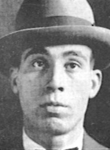
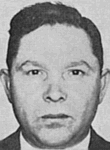
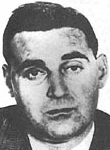
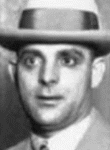
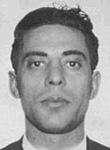
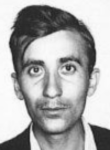
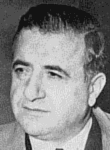
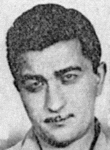
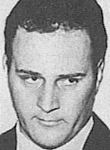
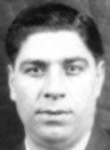
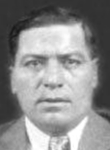
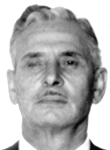
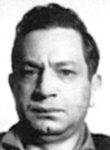
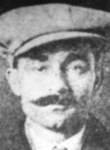
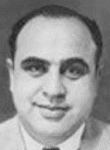
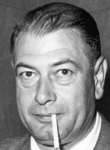

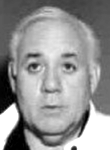

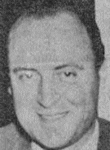
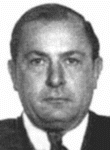
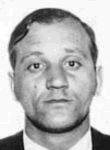
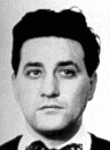
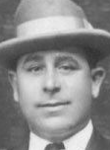
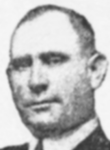
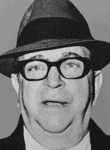
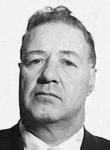
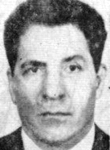
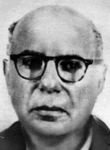
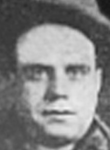
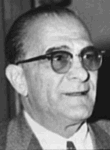
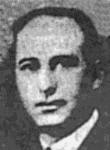
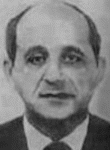

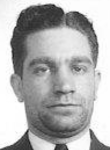
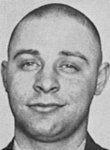
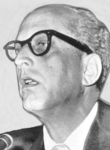
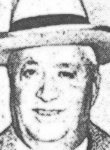
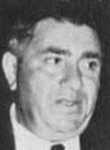
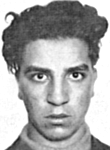
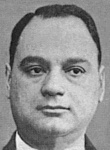

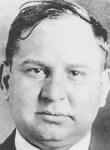

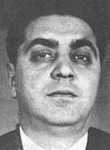
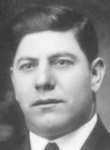
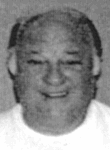
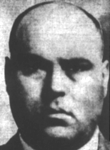
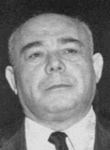
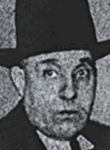
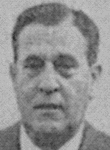
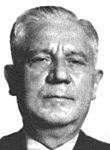
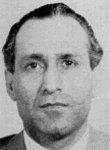

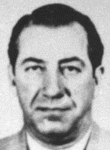
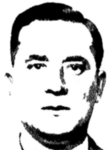
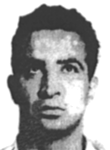
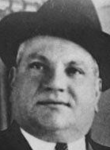
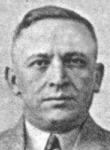
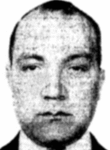
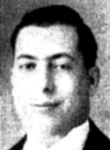
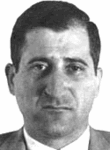
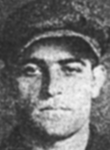
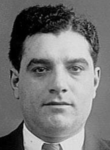
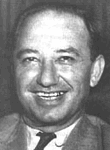
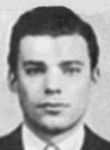
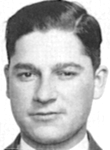
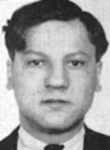
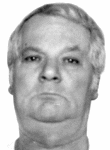
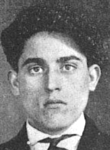
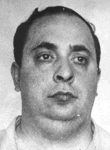
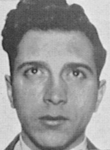
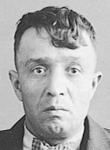
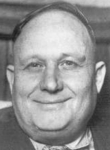
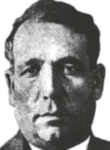
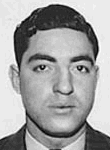
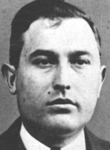
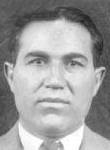
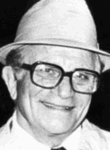
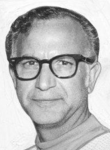

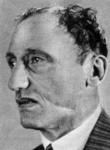
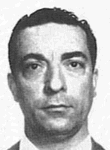
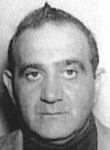
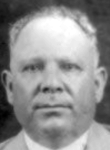
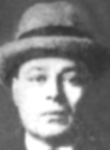
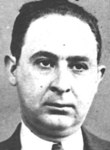
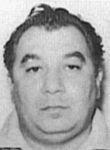
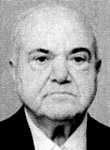
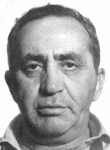
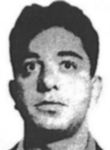
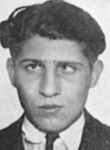
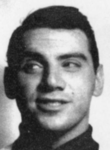
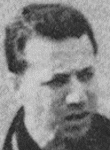
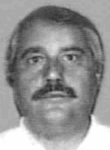
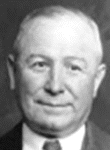
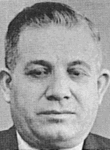
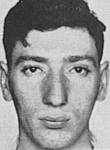
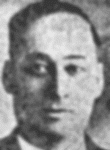
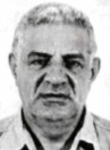
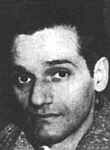
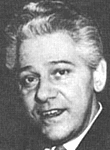
Cassandro Bonasera John Cammilleri Joseph Fino Sam Frangiamore Thomas Hunt Antonino Magaddino Stefano Magaddino Angelo Palmeri Michael A. Tona
Showing posts with label Cammilleri. Show all posts

Joseph Fino (March 13, 1915, - March 13, 1984)


Joseph Fino was born in Milwaukee, Wisconsin, on March 13, 1915. His parents, Rocco (born Aug. 16, 1883) and Angeline Bertoline Fino (born Dec. 18, 1888), were both Italian immigrants to the U.S.

The Fino family moved to western New York when he was a boy. Joseph Fino was an unruly child and a habitual truant from school. At the age of 10, he was sent to Father Baker's Catholic Reformatory in Buffalo and St. John's Protectory reform school in Lackawanna. Before his 16th birthday, he had made more than a dozen appearances in Juvenile Court for offenses including petit larceny, burglary and truancy.
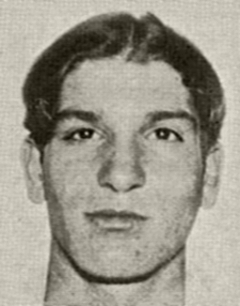
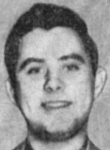
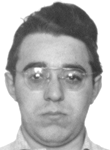
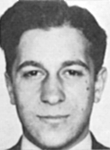
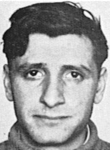
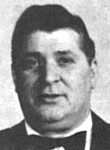
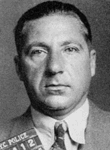
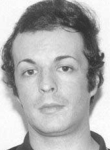
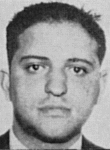
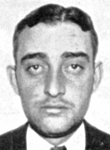
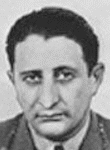
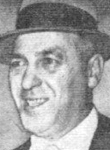
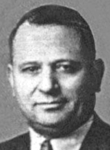
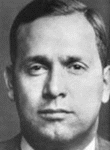
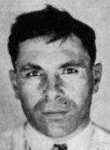
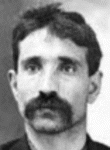
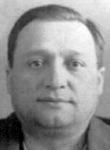
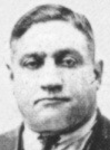
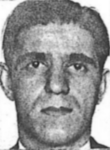
Joseph Fino in 1931
In the spring of 1931, 16-year-old Fino was convicted of burglary and sentenced to one year of probation. After another burglary arrest the following year, he was sent to the New York House of Refuge, a juvenile detention reformatory on Randall's Island in New York City.

Fino received a year sentence in the Erie County Prison following a 1935 conviction for second-degree assault. He was arrested in November 1937 as part of a gang involved in a series of "Lovers' Lane" robberies. Young couples in parked cars in an isolated area of Howard Road were assaulted and robbed by the gang. Fino's record of 22 previous arrests was noted as he was convicted and sentenced to 5-10 years in Attica State Prison. Fino was paroled on Aug. 11, 1943, but returned to the prison five months later as a parole violator. He was released Feb. 14, 1945.

At Attica, Fino developed a close friendship with Daniel Sansanese, who was serving a 30-year sentence for armed robbery. After their release, the two cooperated to manage gambling and loan shark rackets for the Magaddino Crime Family.

In 1945, Fino married Arlene Burkhart.

Fino, Sansanese and Edward Scillia, all of Buffalo, and Russell Mancuso of Utica were arrested June 19, 1950, and charged with the burglary of the Oxford, NY, American Legion Club. Mancuso pleaded guilty to a misdemeanor unlawful entry charge and received a suspended one-year prison sentence and a $500 fine. Guilty pleas by Fino, Sansanese and Scillia resulted in sentences of two and a half to three years in Attica. They were paroled on Oct. 6, 1953. A few years later, Fino and Scillia were arrested for accepting bets on horse races.

Buffalo Evening News, Aug. 20, 1956.
On April 19, 1956, Fino was charged with first degree assault. A complainant identified Fino as the man who fired three gunshots at him from the window of a passing car following an altercation at an Allen Street tavern.

In the 1960s, Fino focused his energies on managing bookmaking, gambling and loan sharking operations for the western New York Mafia. He was closely associated with Mafia leaders in Buffalo and often in company of underlings, such as his brother Nick Fino, Nick Mauro, Ralph Velocci and Salvatore "George Raft" Bonito. He, along with Nick Fino, Mauro and Velocci, were arrested in September 1964 for running a $5,000-a-day bookmaking operation. A jury acquitted the group of bookmaking, convicting them only of the lesser charges of possessing bookmaking records and attempting to destroy evidence.

Fino was among the three dozen men arrested at Panaro's Lounge in May 1967. Charges of consorting with known criminals were dismissed in Buffalo City Court.

Following the imprisonment of Frederico Randaccio, Fino was promoted in 1968 to the position of underboss of the Magaddino Crime Family. The next year, the crime family splintered, as Mafia leaders in Buffalo rebelled against the Niagara Falls-based Magaddino administration. The new Buffalo Crime Family selected Sam Pieri as acting boss, Fino as acting underboss and Joseph DiCarlo as acting consigliere. When Pieri was charged with transporting stolen property in 1970, Fino advanced further to the position of acting boss.

During this period, Buffalo underworld leaders supported the independence of Frank Valenti's criminal organization in Rochester from the Magaddino Mafia. In June, 1970, police officers found leaders of the two rebel organizations - Joseph Fino and Roy Carlisi of Buffalo and Frank Valenti and Rene Piccaretto of Rochester - meeting at a restaurant in Batavia. The group was arrested and charged with loitering and suspicion of intent to commit a crime.

Fino's leadership role in Buffalo made him a top target for federal investigators. In September 1971, a federal grand jury indicted him, Nick Fino, Daniel Sansanese, Sr., and Salvatore Bonito in connection with a multimillion-dollar horse race bookmaking racket. Joseph Fino was found not guilty at trial.

A factional split developed within the Buffalo Crime Family in spring 1973 over whether Victor Randaccio should continue to represent crime family interests in Local 210 of the Laborers Union. Fino, Sansanese and John Cammilleri supported the election of Fino's son Ronald to the business manager post held by Randaccio. The Pieri family, DiCarlo, Carlisi and Joseph Todaro, Sr., remained solidly behind Randaccio. Local 210 voted overwhelmingly for Ronald Fino.

Sam Pieri's December 1973 release from prison restored him to underworld leadership in Buffalo. He quickly took control of Fino's gambling operations. When Fino's close ally Cammilleri resisted, death sentences were issued for both Fino and Cammilleri. Cammilleri was shot to death in May 1974. Fino escaped a similar fate by a fortunate change in plans. He subsequently met with Pieri to negotiate his way out of the death sentence.

In the spring of 1977, federal indictments resulted from an FBI undercover operation at Buffalo Crime Family gambling parlors. Fino, Pieri and several other underworld figures were charged with conspiracy and operation of an illegal gambling business. Fino pleaded guilty to gambling conspiracy in 1979 and was sentenced to four years of probation and a $7,500 fine.

Fino settled into retirement during his probation. He died following a heart attack on March 13, 1984, the day of his 69th birthday.

John Cammilleri (May 8, 1911, - May 8, 1974)

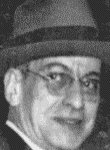
Police surveillance photo of John Cammilleri (left) and Salvatore "George Raft" Bonito

John Cammilleri was born May 8, 1911, to Angelo and Lucia Diana Cammilleri in Campobello Licata, Sicily. He crossed the Atlantic with his mother and three siblings at the age of five, arriving in the U.S. aboard the S.S. Giuseppe Verde on May 30, 1916.

Cammilleri was 19 when he was first arrested. The original charge of grand larceny was reduced to petit larceny, and Cammilleri received a suspended three-month prison sentence and a $10 fine. He was again arrested for grand larceny on June 5, 1931. That charge, stemming from the theft of an automobile, was reduced to malicious mischief and resulted in a $15 fine.

Cammilleri's good fortune in the courtroom continued two months later. He was arrested for first-degree assault after firing a gunshot at Joseph Morabello. The court discharged him.

On Dec. 23, 1931, Cammilleri married Josephine DeCarlo in Buffalo.

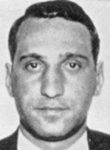
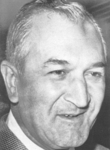
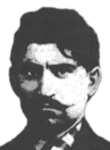
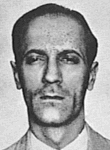
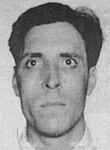
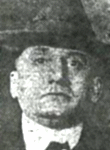
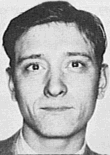
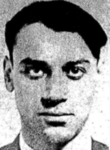
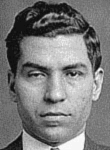
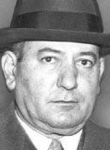
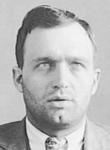
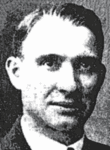
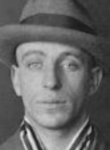
Cammilleri in 1933
The following summer, he was arrested after entering a Dante Place store and stealing $58 from its cash register. Convicted of third-degree burglary, he was given a suspended prison sentence and two years of probation.

At about this time, Cammilleri joined the DiCarlo Gang and began shaking down operators of craps games and bookmaking parlors for a share of their profits. He was arrested Oct. 2, 1933, with DiCarlo Gang members Anthony Tuttino, Sam "Doc" Alessi and George Rolando. The group was charged with first-degree robbery and extortion after holding up John Rogers for $22 and threatening to kill him if he did not make $5 weekly payments to the gang. Cammilleri was convicted and sentenced on Feb. 2, 1934, to a 20-year term in Emira Reformatory.

Cammilleri was labeled "Public Enemy No. 14" on a list compiled by Buffalo Police Commissioner Austin J. Roche, and his criminal record was filed with the FBI.

Released on parole in the summer of 1936, Cammilleri became a construction labor foreman with Laborers Local 210. In 1948, he established the J.C. Concrete Company and began working closely with Victor Randaccio to ensure Magaddino Crime Family control of Local 210. Cammilleri partnered with Frederico Randaccio and "Pat Titters" Natarelli to form Frontier Lathers, Inc., in 1960. The company supplied barricades and construction warning signs. Using his influence over Local 210, Cammilleri was able to extort contactors into using the services of the new company.


Cammilleri was identified as a Magaddino Crime Family lieutenant in a chart prepared for the U.S. Senate's McClellan Committee in October 1963. The FBI kept constant watch on his activities and documented his regular meetings with higher-ups at the Magaddino Memorial Chapel in Niagara Falls. In 1965, the New York Commission of Investigation questioned him under immunity about criminal activities in Rochester.

Cammilleri was among three dozen men, including Joseph DiCarlo, Frederico Randaccio and Pasquale Natarelli, arrested in the May 8, 1967, raid at Panaro's Lounge. Charges of consorting with known criminals were later dismissed in Buffalo City Court.

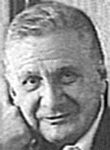
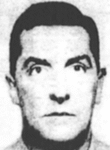
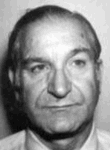
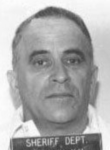
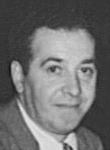
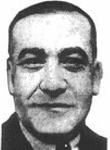
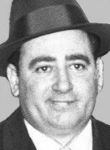
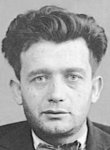
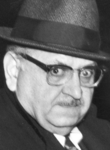
Cammilleri in 1969
As events of the late 1960s drove a wedge between Buffalo Mafiosi and their Niagara Falls-based leadership, Cammilleri lent his support to a rebel underworld faction headed by acting boss Sam Pieri, underboss Joseph Fino and consigliere Joseph DiCarlo.

In 1969, Cammilleri was found guilty of testifying falsely to a federal grand jury. He was sentenced to two years of probation.

Cammilleri's links to organized crime and organized labor came to light in June 1971, as a federal grand jury probed underworld involvement in the construction of Buffalo's new Federal Building. Early stages of the project had been plagued by delays and cost overruns relating to problems with workers from Laborers Local 210. After the contractor hired Cammilleri as a labor coordinator, all proceeded smoothly.

Factions developed within the Buffalo Crime Family in spring 1973, as a disagreement erupted over Victor Randaccio's continued role with Local 210. Cammilleri joined Fino and Daniel Sansanese in support of Fino's son Ronald as Local 210 business manager. DiCarlo, the Pieris, Roy Carlisi and Joseph Todaro, Sr., remained committed to Randaccio. Running on a reform platform, Ronald Fino won election overwhelmingly. However, following his victory, Ronald Fino refused to appoint Cammilleri to his desired position of Local 210 personnel director.

Cammilleri did not keep his disappointment a secret. He spoke angrily with Joseph Fino, expressed discontentment with Pieri's leadership and threatened to pull his crew out of the Buffalo Crime Family.

On the evening of May 8, 1974, Cammilleri celebrated his 63rd birthday with friends at Buffalo's Roseland Restaurant. He left briefly to attend a wake and then went back to the restaurant. As he stepped from his automobile, a light-colored sedan squealed to a stop behind him. A man armed with a .38-caliber revolver jumped out of the sedan and fired three shots, leaving Cammilleri dead on the sidewalk.

1974 police surveillance photo of Cammilleri leaving Roseland Restaurant.


Salvatore Pieri (Jan. 29, 1911, - Aug. 24, 1981)

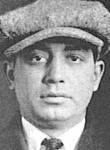
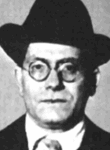
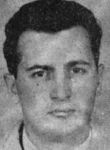
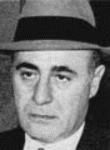
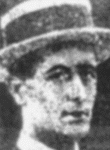
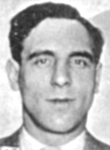
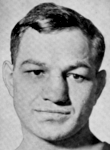
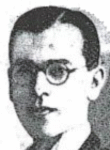
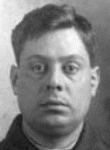
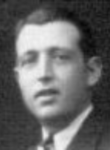
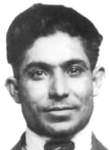
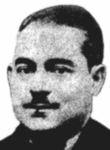
Sam Pieri in 1931

Salvatore "Sam" Pieri was born Jan. 29, 1911, in Buffalo to Sicilian immigrants Giovanni and Ignazia (Anna) Ciresi Pieri. Giovanni and Ignazia were both born in Montemaggiore Belsito, a hilly Sicilian region north of Valledolmo and Vallelunga. Giovanni entered the U.S. on April 20, 1893. Ignazia entered July 1, 1898. They were married in Buffalo's St. Anthony's Roman Catholic Church on Nov. 16, 1900.

Sam was the seventh of nine children born to the couple. His siblings were Salvatora "Elsie" (married to Joseph DiCarlo on Nov. 29, 1924), Vincenza "Genevieve," Adelina, Giovanni "Johnny Rai," Giuseppina "Josephine," Giuseppe "Joe," Stefano "Steve," and Horace "Hobbie."

He first ran into trouble with the law when he was just 10 years old. He was arrested Aug. 7, 1921, for malicious mischief. He was later discharged. Grand larceny and juvenile delinquency charges against him were similarly dropped in 1926. He was charged with truancy on Oct. 27, 1927, and turned over to a truant officer. Sam completed seventh grade and then did not return to school.

As a result of Pieri's first criminal conviction, for second-degree larceny, he was sentenced in June 1928 to an indefinite period of probation.

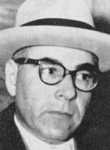
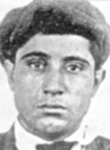
Pieri in 1933

Pieri and brothers John and Joe became members of the DiCarlo Gang. Working for their brother-in-law Joseph DiCarlo, they extorted payments from operators of craps games and bookmaking parlors.

Sam Pieri and fellow DiCarlo Gang member Joe "the Goose" Gatti were arrested Jan. 6, 1931, along with two other alleged accomplices. They were charged with first-degree robbery in connection with the $3,000 armed holdup of a gambling establishment in Rochester. The charge was eventually dropped.

Pieri was less fortunate later that year. On Sept. 2, he and two other men were arrested as they unloaded 300 quarts of Canadian ale from a rowboat at the foot of Buffalo's Hudson Street. (A fourth member of the bootlegging group escaped by swimming away.) Pieri was convicted of bootlegging and tariff violations and sentenced to 60 days in Erie County Prison.

Pieri and "Goose" Gatti escaped conviction on another first-degree robbery charge in the spring of 1933. By the end of that year, 22-year-old Pieri made Buffalo Police Commissioner Austin J. Roche's list of Public Enemies (No. 12).

On Jan. 23, 1934, Pieri married Caroline LoTempio. DiCarlo Gangster and future Cleveland crime boss John "Peanuts" Tronolone was Pieri's best man.

Pieri, Tronolone, Anthony "Lucky" Perna and others were arrested in spring 1935 for violating the new Brownell Law, which made consorting of criminals unlawful. Though the men were convicted, their six-month prison sentences were suspended.

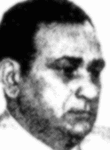
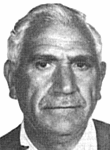
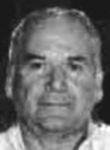
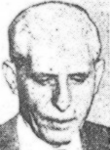
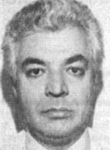
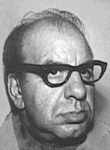
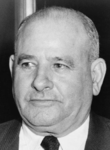
Pieri in 1969

Pieri earned the respect of western New York crime boss Stefano Magaddino the following year, as he imposed mob discipline upon a relative. The LoTempio brothers, Pieri cousins, were believed responsible for a May 1936 bombing that took the life of Magaddino's sister. The LoTempios were rebelling against a Magaddino-imposed tax on their gambling rackets. Pieri arranged for Frank LoTempio to attend the wedding of a relative in Buffalo. Following the reception, Pieri escorted LoTempio to his car. After a short conversation, Pieri shook LoTempio's hand and turned away. Two men emerged from a nearby parked vehicle and shot LoTempio to death.

The 1949 disappearance of gambler Patsy Quigliano was also linked to Pieri. Quigliano was deeply in debt to mob higher-ups, and Pieri reportedly was to transport him to meet with Joseph DiCarlo in Cleveland on the day he disappeared.

In the early 1950s, a three-year Federal Bureau of Narcotics investigation pointed to Sam Pieri and Salvatore Rizzo as the regional leaders of a heroin and cocaine smuggling ring involving Buffalo, New York City and Cleveland. Pieri and Rizzo were arrested May 22, 1954. Charges against Rizzo were dismissed. Pieri was convicted and sentenced to 10 years in Atlanta Federal Prison. He was released May 7, 1963.

The prison term enhanced Pieri's stature in the underworld. Within the institution's walls, he established strong relationships with members of the Profaci and Genovese crime families and became especially close to jailed crime boss Vito Genovese. Upon Pieri's release, law enforcement officials wondered if he might become more powerful than Magaddino underboss Frederico Randaccio or possibly Magaddino himself.

The Magaddino organization was staggered by the imprisonment of Buffalo underworld leaders Randaccio and Pasquale Natarelli in December of 1967. Pieri and DiCarlo took advantage of the situation, mobilizing elements of the old DiCarlo Gang to take control of gambling rackets in Buffalo.

Claiming there had been a dramatic dropoff in underworld revenues, Magaddino imposed additional taxes on his men, refused to assist in gambling racket financing and eliminated bonuses he had previously paid to his lieutenants. In November 1968, Magaddino was proved a liar, as federal agents discovered nearly a half-million dollars in cash hidden in a wall of his son Peter's home.

The events of the 1960s drove a wedge between Buffalo Mafiosi and the organization's Niagara Falls-based leadership. In July 1969, a rebel Mafia faction in Buffalo selected Pieri as its acting boss, Joseph Fino as its acting underboss and Joseph DiCarlo as its acting consigliere. When informants brought the news to the FBI, Pieri became the Bureau's top target in Buffalo.

Pieri, Anthony Romano and Ralph Jacobs stood trial in 1970 for transporting stolen jewelry. As the state was concluding its case, authorities heard evidence that Pieri had attempted to bribe a juror. A mistrial was declared, and Pieri was charged with obstruction of justice. He was convicted of jury tampering and sentenced to five years in federal prison.

Pieri in 1975

When paroled in December 1973, Pieri immediately returned to his top position in the Buffalo Crime Family. Capodecina John Cammilleri's brief challenge to Pieri's leadership ended with Cammilleri's murder on May 8, 1974.

The FBI's next move against the Pieri administration consisted of inserting an undercover agent into two Buffalo gambling clubs that featured high-stakes Ziganette card games. As a result of the investigation, Pieri was found in violation of his parole and returned to prison to complete his jury tampering sentence.

Upon his release, Pieri found federal authorities ready to try him for conspiracy and gambling in connection with the Ziganette parlors. Pieri eventually pleaded guilty to conspiracy and was sentenced to a year in prison.

Securing his release after four months, Pieri sought to reestablish discipline in a criminal organization that had been shaken by informants and law enforcement infiltration. The May 1980 murder of William "Billy" Sciolino, a mob informant, was intended as an example.

Less than a month later, the partly decomposed body of Carl Rizzo was found in the trunk of a car. Rizzo was initially suspected of also being an informant, but investigators learned he had been involved in a Pieri-sponsored racket related to union dental plans.

Pieri's hold on the Buffalo Crime Family was weakened with the October 1980 death of Joseph DiCarlo. DiCarlo provided continuity during Pieri's prison sentence and conferred legitimacy upon Pieri's leadership claims.

Seven months later, Pieri became seriously ill. He passed away Aug. 24, 1981, at the age of 70.

Pieri gravesite